

Why is the Army Corps ignoring the Supreme Court?
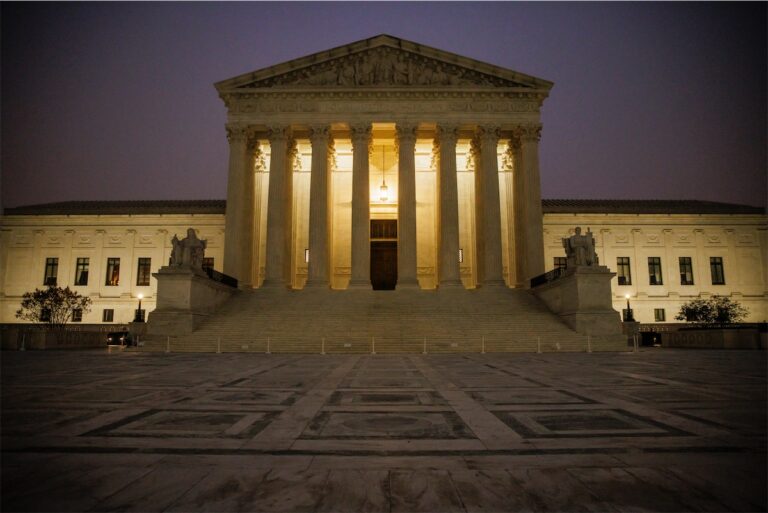
When Mike and Chantell Sackett won their case against the Environmental Protection Agency (EPA) in 2023, their victory strengthened property rights not just for them, but for individuals across the entire country.
For decades, the EPA, along with the Army Corps of Engineers, had been broadly interpreting the Clean Water Act’s (CWA) definition of “navigable waters” to classify semi-soggy parcels of residential land as protected wetlands. As the Sacketts learned, once the federal government cries wetlands, property owners are not just stripped of their right to use their own land but are subject to civil penalties exceeding $68,000 per violation, per day.
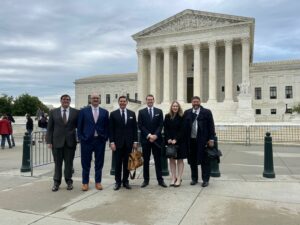
The Sacketts spent over a decade fighting the EPA, even making an exceedingly rare double-trip to the Supreme Court. In the end, the Court vindicated the Sacketts and reined in the EPA’s power, instituting stricter standards for determining federal authority over wetlands.
The Sackett decision was a pivotal moment for property owners, who should have felt its far-reaching effects. But it didn’t take long for the federal government to begin ignoring the Court’s ruling and start going after property owners once more. And in a jaw-dropping display of audacity, the most recent example of the government’s disregard for the Sackett ruling comes from the very same county where the Sackett case originated.
Soggy land or protected wetlands?
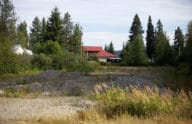
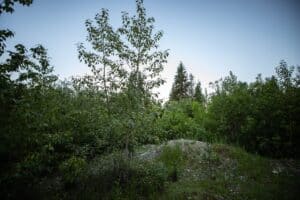
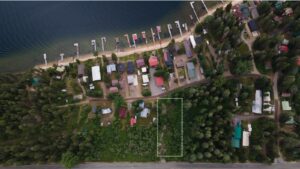
Bonner County, Idaho, is home to Caleb and Rebecca Linck, who own 4.7 acres near the small city of Kootenai. On paper, they have owned the land for five years, but it has been in Caleb’s family for four decades. And while he did not grow up on the land, Caleb was raised nearby and spent a great deal of his life there.
There isn’t much on the property. The land is zoned for agricultural purposes and that is exactly how the Lincks plan to use it. But living out their dream of a quiet life on their property has become more complicated than it should be, ever since the Army Corps of Engineers alleged that 1.3 acres of the Lincks’ land is a federally protected “wetland.”
When the Lincks acquired ownership of their property, they were proactive in making sure they were in full compliance with the law. There is a sometimes-damp area on the property that is about a mile away from Bonner Slough, a stream that allegedly flows year-round and connects to Lake Pend Oreille—a known navigable water two miles from the Lincks’ property. It seemed unlikely that this would qualify as a protected wetland, especially post-Sackett. Even so, the Lincks did their due diligence and hired a wetlands consultant who sought an Approved Jurisdictional Determination (AJD), which is the Army Corps’ official declaration of an entity’s status as federally regulated under the CWA.
The wetlands consultant was confident that the Army Corps would assess the site and issue a negative AJD—meaning it was not a federally protected wetland. Instead, the Army Corps concluded that the site was protected under the CWA, thus triggering the significant restrictions associated with such a declaration, and severely limiting the Lincks’ future use of the property.
When determining if a site is a federally protected wetland, the operative question is whether it qualifies as “navigable waters.” The term “navigable waters” might seem self-evident and bring to mind a body of water that could be, well … navigated, in the sense that it connects to other bodies of water—especially where those bodies of water are used for commerce: i.e., the Mississippi River and the Great Lakes. But the Army Corps, and the EPA, have historically taken liberties when defining “navigable.”
In this case, the Army Corps determined that this soggy patch of land and Lake Pend Oreille were connected—even though they are two miles apart—and therefore navigable and protected. Trying to make sense of these claims requires some serious mental gymnastics.
Let’s take a closer look at the alleged wetlands on the Lincks’ property. To the north, the site is bordered by Porath Road, a 35-foot-wide county gravel road with ditches on both sides. However, these ditches don’t connect to any other water channels. North of the road is a large pasture with an alleged natural wetland depression—or “swale”—that touches an unnamed tributary of Boyer Slough. This tributary is about 350 feet from the road.
There are no culverts linking the Lincks’ property to the swale across the road. Evidence also indicates that the swale doesn’t typically contain flowing surface water; it’s just an isolated, soggy piece of land.
Put simply, the Army Corps claims the Lincks’ property is a federally protected wetland because it’s a soggy patch near another soggy patch, across a gravel road, that eventually drains into a lake two miles away. This is as ludicrous as saying your backyard is part of a protected wetland because it’s damp in the spring after it rains and it’s across the street from a ditch that runs near a creek, that runs into a river, that eventually touches a lake.
Under the pre-Sackett standards, the Army Corps reasoning has legs. But unless the Corps has found a way to travel back in time, before the Court’s 2023 decision, these claims have no standing today.
Navigating the pre- and post-Sackett eras
Since it was passed in 1972, the CWA has given the federal government the authority to regulate “navigable waters.” The problem is that the two agencies responsible for implementing the CWA—the EPA and the Army Corps—usurped to themselves the power to define what “navigable waters” actually meant.
The pre-Sackett era was the wild west for CWA regulators, who very broadly interpreted the term to satisfy their own ends. At the time, the only test they needed to apply was the “significant nexus” test, which basically said a wetland need only have a (vaguely defined and often highly abstract) “connection” to some downstream water. These loose standards wreaked havoc on property owners who had no idea their property would fall under the CWA’s authority.
Recognizing that test’s shortcomings, the Court rebuked the agencies’ approach in Sackett. Under the Sackett test, the Court affirmed that federal regulation under the CWA extends only to traditionally recognizable bodies of water—like rivers, lakes, and streams—that are relatively permanent and continuously flowing. In other words, a navigable “water” should be obviously water. “Wetlands”—which are not traditionally recognizable “waters”—may be regulated only incidentally to such bodies of water. Thus, federally regulated wetlands must have a continuous surface water connection to, and be indistinguishably part of, a body of water.
By the Sackett standards, the Lincks’ land cannot possibly contain federally protected wetlands.
For starters, the alleged wetlands do not have a continuous surface water connection to bodies that are “waters of the United States.” They are separated by a road. In Sackett, the Court held that “a barrier separating a wetland from a water of the United States would ordinarily remove that wetland from federal jurisdiction.” Notably, the Court emphasized that the Sacketts’ lot was separated from jurisdictional waters by a 30-foot-wide road—five feet narrower than the road dividing the alleged wetlands on the Lincks’ property.
Not to mention, the Army Corps’ justification for linking and treating the site on the Lincks’ land and Lake Pend Oreille as one federally regulated wetland assumed similarities in vegetation, soil, and a subsurface hydrological connection. But the Court explicitly rejected reliance on ecological factors or subsurface connections in Sackett, emphasizing that the Clean Water Act governs “waters,” not land features like saturated fields or disconnected wetlands.
The Corps’ reasoning not only fails the Sackett test, it defies it by reasserting a theory functionally identical to the theory rejected in Sackett … in the very same county as the Sacketts’ property.
To call the Army Corps’ conduct brazen would be an understatement. Instead of heeding the Sackett ruling, as the law requires, the Army Corps wanted to see how far it could stretch its authority without being challenged.
The unfortunate truth of the matter is that government agencies of all kinds will always push the limits, expecting that most individuals will lack the resources to fight back. This is exactly what keeps Pacific Legal Foundation so busy. We helped the Sacketts fight for over a decade and now we are helping the Lincks hold the Army Corps accountable to the Supreme Court’s ruling.
If unelected, regulatory agencies like the Army Corps can ignore the law when it suits them, no property owner is safe.