

Uneven playing field: A family business fights back against unconstitutional citizen suits
Who should have the power to enforce the law? The Constitution reserves that power for the executive branch. But what happens when that authority is delegated away and placed into the hands of private, unelected citizens?
For Pacific Legal Foundation client Craig Deleo, the question isn’t merely theoretical. For the better part of a decade, he has been living with the consequences.
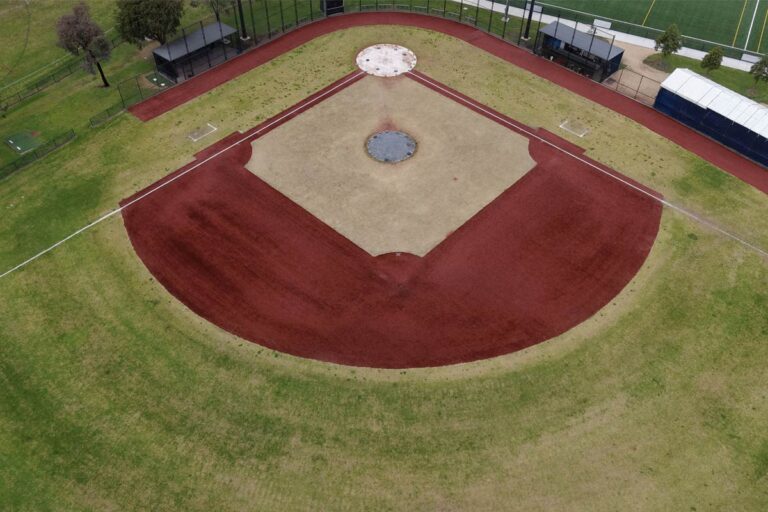
Craig’s family business, Corona Clay, is best known for supplying the distinctive copper-toned infield dirt that stands out on baseball diamonds. For decades, the Anaheim Angels played ball on a mixture of crushed clay and brick that Craig’s dad developed especially for their stadium. The family also provided infield materials for minor and little leagues across Southern California.
But the company, which has been in the Deleo family for three generations, was thrown a curveball in 2017 that has placed its future in jeopardy. Since then, they have found themselves on an uneven playing field, defending their business against a federal lawsuit brought not by the government, but by two private environmental organizations.
Building a family legacy
In 1958, the Deleo family celebrated two milestones: the founding of Corona Clay and the birth of Craig Deleo, the grandson and son of the men who built the business.
Hard work runs in the Deleos’ DNA. Craig’s grandfather began working at a Ford dealership at age 12, fixing cars. By 14, he had his own little side business revamping old cars and selling them. When he got older, he became a proper mechanic, working alongside several clay workers, which ultimately led to him working in a clay mine.
The company came from humble origins. In the beginning, Craig’s grandfather owned no property of his own. Instead, he rented a hillside clay deposit where workers would extract the clay and load it onto pickup trucks. As the company grew, so did the trucks they used to haul the clay from the mines. In Corona Clay’s pre-baseball days, the material was mostly used to make tile, brick, and sewer pipe.
Like his father, Craig’s father was drawn to hard work and eventually began driving a truck for Corona Clay. In 1966, the California Angels, as they were called then, came to Anaheim and Corona Clay started supplying the materials for their baseball field.
“My dad made the mix for their ball field out of crushed brick and clay,” Craig says, proudly.
This was a big deal for the family, especially Craig’s mother, who loved baseball.
“My mom was a hardcore fan. She loved it. She had their little radio every day with the games, and she listened to every game. And then eventually we got season tickets.”
While the company’s ties with Angel Stadium stopped shortly after the team won their only World Series in 2002, their ties to baseball continue to this day. “We still sell it to most of the little leagues in Southern California. At the time, we were still doing all the Lake Elsinore Storm, the 66ers, the Adelanto has a single-A ball club, and then UCLA, USC,” Craig says.
Like his father and grandfather before him, he loved to work with his hands. When Craig was 12, his grandfather bought a sewer pipe plant. Craig spent his summer waking up at four in the morning and accompanying his grandfather to the plant, where he was tasked with watching the machines to ensure they didn’t break.
His grandfather was a serial entrepreneur and Craig often found himself helping with whatever new company he was building. From farming avocados to planting trees to drilling rocks with a jackhammer and eventually digging ditches for Corona Clay, Craig did all sorts of manual labor for his grandpa.
As he got older, he continued to work hard every day while he attended college. He also loved to surf. While he had dreamed of becoming a pilot for the Navy, he discovered he did not have 20/20 vision and would not meet the Navy’s vision standards. Eventually, he was accepted to law school but turned it down, choosing instead to keep working as a heavy equipment operator, learning how to weld, operate heavy machinery, and do concrete work.
Aside from a brief stint when he went to help his grandfather run a separate tile-manufacturing company, Craig has been with Corona Clay ever since.
Three generations of Deleo men helped turn Corona Clay into what it is today, but Craig’s daughter has helped continue the tradition of hard work for the next generation. “She is very physically strong. She can carry a 90-pound bag of concrete like it’s nothing,” Craig says. While she usually works alongside her dad, she has been taking time off after giving birth to Craig’s second grandchild.
Craig has immense pride for everything his family has built. But he never thought he’d spend nearly ten years fighting to preserve that legacy.
A legal battle begins
Sometime before 2013, Craig discovered that another local clay business had been threatened with litigation over stormwater runoff by a private environmental organization called Inland Empire Waterkeeper. Craig wasn’t content to sit back and wait for the organization to come after his family’s business. He proactively hired an environmental engineering consultant to help Corona Clay comply with stormwater regulations, cleaning up the property, and installing measures to control runoff.
Under California’s industrial stormwater permit, Corona Clay was required to control pollutants in stormwater runoff and comply with monitoring, sampling, and reporting requirements. But the outside consultants didn’t always get everything right, leading to problems with the company’s permit compliance. California regulators issued Corona Clay several notices of violations but did not pursue a federal enforcement lawsuit.
In December 2017, Inland Empire Waterkeeper, along with another private environmental group—Orange County Coastkeeper, sent a notice of intent to sue to Corona Clay, the EPA, and California state regulators. The two groups alleged that the company was violating the Clean Water Act (CWA) through stormwater discharges to Temescal Creek, along with claims of other permit violations.
In the spring of 2018, the two environmental groups made good on their threat, bringing a federal lawsuit and asking the court to levy penalties of up to $51,570 per day per violation on Corona Clay.
The judge granted summary judgment on two of the claims, siding with Inland Empire Waterkeeper and Orange County Coastkeeper. However, in 2019, a jury ruled in Corona Clay’s favor on other claims. Because of the two claims already decided by the judge, the court imposed $3.7 million in civil penalties on Corona Clay.
Both sides appealed, and in 2021, the Ninth Circuit set aside the earlier judgment—including the $3.7 million penalty.
But Corona Clay had not been cleared of wrongdoing, and Craig’s legal ordeal was far from over.
In 2022, a second jury trial ended in a verdict against Corona Clay, followed by a new $1.8 million penalty. In January 2024, the judge also ordered the company to pay another $3.7 million in the environmental groups’ attorneys’ fees and litigation costs.
Craig was devastated. He had experienced a moment of relief after the 2019 jury’s verdict. only to have his hopes dashed once again. “I’m not the kind of guy that cries like I cried when we won the first lawsuit,” Craig recalled. “And then when we lost [the] second one, I was like, ‘Oh boy, I’ve seen that coming a mile away.’”
The jury found Corona Clay responsible for thousands of permit violations involving pollution-control measures, monitoring, and reporting. The company appealed once again.
That two private groups could wield so much power over the enforcement of the CWA was concerning, to say the least.
But the case rested on another important question: Did Temescal Creek even fall under the jurisdiction of the Clean Water Act in the first place?
Under the Clean Water Act, federal regulatory authority extends to what Congress called the “waters of the United States” (WOTUS). For decades, federal agencies interpreted that language broadly to include even small, temporary bodies of water that appeared after rainfall and eventually dried up.
That changed in May 2023, when the Supreme Court ruled in favor of PLF clients Michael and Chantell Sackett. In Sackett, the Court rejected the government’s expansive interpretation of WOTUS, establishing a narrower standard for determining which waters and wetlands fall under the CWA.
The timing mattered enormously for Corona Clay.
Six months earlier, Corona Clay’s second jury trial had concluded. During the proceedings, the jury had been instructed to accept that Temescal Creek qualified as a federally protected waterway. But it had never independently determined whether the creek met the narrower standard established by Sackett.
In light of the Sackett decision, the Ninth Circuit ruled in September 2026 that Corona Clay could reopen the question of whether Temescal Creek qualified as federally protected waters, giving Craig and his family business another day in court.
But whether Temescal Creek falls under federal jurisdiction is only part of the legal battle.
After nearly a decade of litigation, Pacific Legal Foundation joined Corona Clay’s fight to challenge something even more fundamental: the authority of the private environmental organizations that brought the lawsuit in the first place.
Who has the power to enforce the law?
The Constitution’s Framers were careful to task each branch of government with specific duties—each serving as a check on the others. The legislative branch makes laws, the judicial branch interprets laws, and the executive branch enforces the laws. Nowhere does the Constitution give the legislative branch the power to delegate away the executive’s enforcing powers to private citizens.
Yet under a provision of the CWA enacted in 1972, Congress gave private individuals and organizations the authority to sue businesses for alleged violations of federal environmental regulations, seeking civil penalties that would ordinarily be pursued by the executive.
Under the Constitution’s separation of powers, each branch is accountable to the others. But when private organizations pursue federal enforcement lawsuits, they are accountable to neither the government nor the people.
In Corona Clay’s case, neither the EPA nor California regulators pursued enforcement litigation against the company. That should have been the end of it.
Giving this much power to private citizens is not only unconstitutional, it’s also ripe for abuse.
According to PLF research, since 1996, Inland Empire Waterkeeper and Orange County Coastkeeper have brought 96 nearly identical suits against companies like Corona Clay. And there’s no telling how many more they could file if allowed to continue bypassing the Constitution’s separation of powers.
Everything to lose
Craig has routinely described himself as a “simple guy.” All he wanted was to continue building his family’s legacy. Instead, he has been forced to spend years in a tumultuous legal battle.
When asked what winning this case would mean to him, he replied, “That I get to sleep normally, I guess.”
The years of litigation have taken their toll, but Craig is grateful to have PLF fighting alongside him. “We keep throwing cards into the pile with everything to lose, and [the environmental groups] have nothing to lose,” he says. “Now, [PLF] have a chance to take their whole pile back and not let them have it from anybody else.”
Craig has everything at stake. The environmental groups have nothing to lose. And that is precisely why the Constitution places the power to enforce federal law in the hands of an accountable executive branch—not private organizations free to pursue their own agendas.
Pacific Legal Foundation is fighting to restore that constitutional boundary so that Craig—and countless others like him—doesn’t have to lose his life’s work to an unconstitutional citizen suit.