


A guide to your rights and searches of personal property when traveling

Americans do not surrender their constitutional rights when they travel. Yet, currently, Department of Homeland Security (DHS) policy hands U.S. border officials broad authority to conduct warrantless searches and seizures of electronic devices at ports of entry and of vehicles at checkpoints within 100 miles of the border.
That policy is doing immediate, tangible harm to Americans’ rights. Consider Pacific Legal Foundation client and Vermont school superintendent Wilmer Chavarria, who was detained by Customs and Border Protection after returning to the U.S. from visiting family in Nicaragua. Despite being a naturalized American citizen guaranteed the Constitution’s protections, Mr. Chavarria was told he had no Fourth Amendment rights at the border. He was subjected to hours of questions, and his electronic devices were seized and searched—without a warrant or suspicion.
Mr. Chavarria filed a federal lawsuit to challenge the policy handing government employees an excuse to disregard the Constitution. While lawsuits like his continue to press the courts to affirm Americans’ rights, many are unfortunately left in the dark about what exactly their rights are when traveling.
This explainer breaks down common questions about your Fourth Amendment rights while traveling, including why searches like the ones Mr. Chavarria was subjected to are unconstitutional—and how to reduce the likelihood of facing unreasonable searches yourself.
What is the 100-mile border zone?
While “ports of entry” are specific locations—such as airports, land border stations, and seaports—the 100-mile “border zone” encompasses a much larger area. Under the Immigration and Nationality Act of 1952, border agents from Customs and Border Protection (CBP) and Immigration and Customs Enforcement (ICE) have the power to search without a warrant any vessel in U.S. waters and any railway car, aircraft, or vehicle within a “reasonable distance” of the border. In 1953, federal regulations defined a “reasonable distance” as “100 air miles” of any external U.S. boundary. This is the same definition used today.
Doesn’t the Fourth Amendment protect my personal property at ports of entry and in the 100-mile border zone?
CBP has asserted authority to conduct warrantless searches of electronic devices at ports of entry and the border. But without clear limits on how invasive these searches can be and what can be searched, travelers—regardless of their citizenship—could be subjected to warrantless searches based on individual agents’ interpretations of broad DHS guidelines.
The U.S. Supreme Court has held that warrantless routine searches of vehicles stopped in the 100-mile border zone and checkpoints within are constitutional. This carveout is called the border search exception, and the Court notes that routine searches do not require probable cause or reasonable suspicion because of the government’s heightened interest in protecting the border.
However, the Court has not clearly defined what makes a search “routine” versus “non-routine” in this carveout. Until it clarifies this, and while the “reasonable distance” remains 100 miles, most Americans’ constitutional rights will remain far from guaranteed.
Where and how are searches conducted in the 100-mile border zone?
Research indicates that within the border zone, there are 224 active interior checkpoints. Only about 15 percent of these checkpoints are permanent locations located along major roads. The rest are tactical, meaning they are temporary and can move over time, and are often found on smaller, secondary roads.
When a stop is conducted at these checkpoints, border agents can briefly question drivers and quickly observe what is in plain sight inside their vehicles without a warrant or individualized suspicion. They can also have a drug-sniffing dog sniff around the exterior of your vehicle.
To search your vehicle or belongings, a border agent would need either to get your consent or provide probable cause that you committed an offense. Although you have the right to remain silent, border agents may interpret silence as a reason to suspect you of an alleged offense. You can record the interaction and ask the agent to provide the basis of probable cause—such as what they observed, a records check, or a canine sniff.
Can CBP officers search my phone, laptop, or other electronic devices at ports of entry without a warrant?
Under current CBP policy, officers may conduct a basic search of an electronic device at a port of entry without any suspicion that you have committed a crime. A basic search involves visually inspecting a device and scrolling through its contents, without copying or storing any data.
With approval from a senior official and reasonable suspicion of a crime, or even without suspicion in cases where a national safety concern exists, officers may also conduct more invasive, advanced searches using external equipment to review, copy, and retain device contents for later analysis. Only data relevant to immigration, customs, and other CBP enforcement matters or evidence of a violation of a CBP-enforced law can be copied and stored.
Despite the heightened approval requirements for advanced searches of electronic devices, CBP acknowledges those requirements only partially mitigate the privacy risks, given the volume and breadth of data it collects from electronic devices.
How have warrantless device searches at ports of entry grown over time?
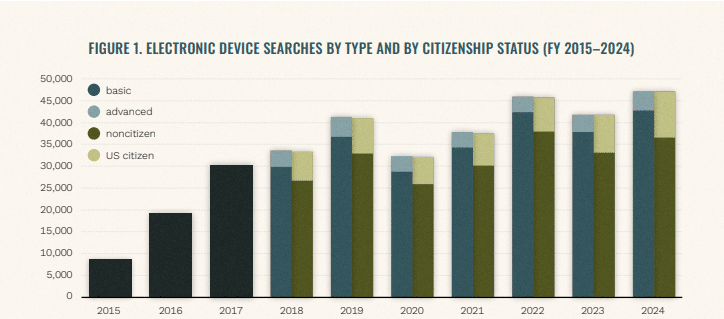
According to research conducted by Pacific Legal Foundation, basic and advanced device searches have quadrupled over a decade—from 8,500 searches in 2015 to over 46,000 in 2024. The lion’s share of these searches were basic, but about 10 percent of them were advanced searches. About 20 percent of searched devices belonged to U.S. citizens.
What can CBP officers do with information taken from my electronic devices?
If evidence of criminal activity is found on an American citizen’s devices, searches can result in arrest. Non-citizens have been detained and denied entry to the U.S. based on the results of searches.
Even if evidence of criminal activity is not found, the information from advanced searches can be kept on a computerized system called the Automated Targeting System (ATS) for up to 15 years or the life of the law enforcement matter (whichever is longer). The information can be shared with other agencies and is used to create a risk profile. Additionally, border agencies and other government agents can use ATS to decide whether to flag you for secondary inspection during future border crossings.
What happens if I refuse to provide my password?
You will not be arrested for refusing to provide officers with your device’s password. However, you could be subject to interrogation and seizure of your electronic device or the contents on it, even if the confidentiality of those contents is protected under federal law. Some people report that their devices have been held for weeks or months.
What can I do to protect myself until the Court issues clarification to strengthen Fourth Amendment protections for travelers?
Generally, you can refuse an intrusive search of your property or ask for their basis for reasonable suspicion. Also, you can exercise your right to remain silent when asked speculative or probing questions that do not relate to your citizenship or right to enter the country. Documenting these interactions, officers you interacted with, length of detention, property confiscated, and other facts can be helpful for building a case.
For electronic devices, do not carry non-essential devices when you travel. You can protect your essential devices when crossing the border or ports of entry by turning the devices off and logging out of sensitive cloud services.
How can I vindicate my rights if my devices are searched and seized without a warrant?
Pacific Legal Foundation seeks to protect Americans’ right to be secure from unreasonable searches and seizures of private property and represents those who have experienced such government offenses. If you feel that you have experienced an unreasonable search or seizure of your private property—at the border or otherwise—please submit your case for consideration.