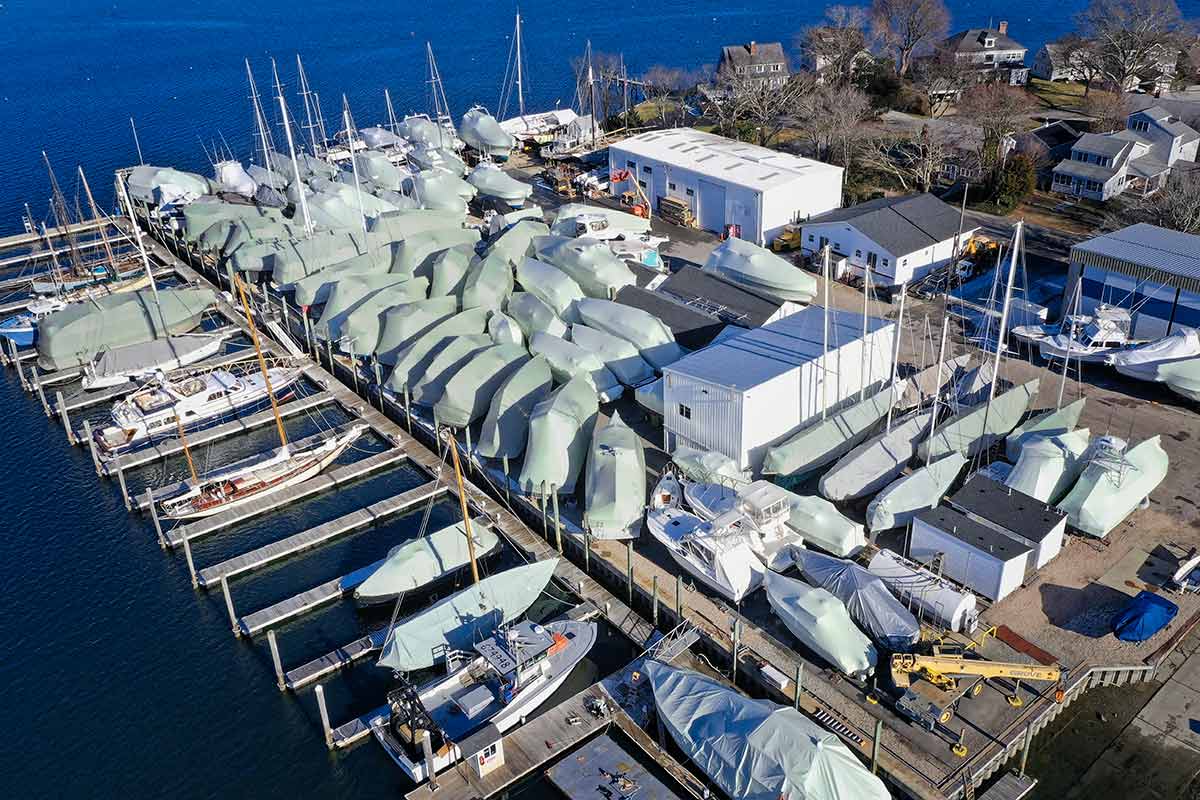
Simon Milne was in Newport, Rhode Island, when he noticed a persistent problem in the sailing community. Every spring, boat owners stripped plastic shrink wrap off their boats and sent it to landfills, where it would sit for centuries. Plastic can take 100 to 1,000 years or more to decompose.
Newport locals had few alternatives to protect their boats during harsh winters, and recycling options were limited and largely ineffective.
Armed with background knowledge in air cargo, oil spill remediation, and advancements in plastic manufacturing, Simon began brainstorming a better way. He founded bioaqualife to create genuinely sustainable commercial solutions. The company eventually launched bioWRAP, a landfill-biodegradable shrink film designed to replace conventional plastic wrap.
BioWRAP meets or exceeds traditional shrink wrap in durability, UV protection, weldability, and heat-shrink speed. It has an unlimited shelf life—but once it’s placed in a landfill, microbial activity triggers its full biodegradation within three to five years.
With approximately 810,000 registered recreational boats and about 750 marinas, yacht clubs, and storage facilities statewide, Minnesota is a prime market for bioWRAP.
But in 2024, the Minnesota Legislature effectively locked Simon’s business out of the state.
Lawmakers created a “product stewardship program for boat wrap” requiring every producer and seller in Minnesota to join and pay into a private organization: the Commercial and Industrial Flexible Film Recycling Organization (CIFFRO). The law lets CIFFRO write and enforce a “stewardship plan” that every boat wrap producer must follow and finance. CIFFRO was created and governed by the state’s two largest incumbent manufacturers and processors of conventional, non-biodegradable plastic shrink wrap—in other words, bioaqualife’s direct competitors.
The plan sets aggressive quotas: Producers must collect and recycle 50 percent of the total weight of boat wrap sold in Minnesota by 2030, and 80 percent by 2035. But the law measures sustainability through only one metric: mechanical recycling. Biodegradation, despite its superior environmental performance, is legally classified as landfill “disposal,” even though it’s engineered to vanish naturally within three to five years.
Simon decided to challenge the scheme in court, represented free of charge by Pacific Legal Foundation. The lawsuit argues that by handing its regulatory power to a private organization run by bioaqualife’s competitors, Minnesota’s law violates the Constitution’s protection against unaccountable private actors wielding government power.
By forcing Simon to join and financially contribute to an organization he never chose to be a part of—and by prohibiting his company from transparently communicating the financial burden of membership through customer fees—the law violates the First Amendment as well.
The lawsuit also challenges the scheme under the Commerce Clause, which forbids states from unjustifiably burdening interstate commerce. By forcing an out-of-state innovator to subsidize local mechanical recyclers or face complete exclusion from the market, Minnesota has erected an unconstitutional economic barrier to protect entrenched domestic interests from interstate competition.
The Constitution doesn’t let unaccountable private actors wield government power. Minnesota shouldn’t be able to deputize an industry’s largest incumbents to regulate, fund, and speak for the businesses they compete against. And if the State wants to set environmental policy, it should measure what actually helps the planet, not enforce one company’s preferred process while punishing those who find a better way. A win for Simon would affirm that no company should have to answer to its own rivals just to do business in Minnesota.
What’s At Stake?
- The government cannot hand regulatory power to a private organization controlled by a business’s competitors.
- The First Amendment forbids the government from forcing a business to fund, join, and speak through a private trade organization against its will.
- States cannot erect protectionist trade barriers that penalize out-of-state innovators to insulate local commercial incumbents from competition.