

Justice Thomas says the quiet part out loud in Pung
Yesterday, the Supreme Court delivered its decision in Pung v. Isabella County, ruling against the Pung family.
In February, the Pungs asked the Court to affirm that when the government takes and sells a home to satisfy a tax debt, just compensation should be measured by the home’s fair market value—not whatever price the government happens to obtain at auction.
In a disappointing decision, the Supreme Court ruled that the Constitution does not require governments to pay homeowners fair market value when property is sold through a properly conducted foreclosure sale.
But the Pungs’ story is not over.
Although the Court rejected the fair market value claim, members of the Court went out of their way to emphasize the narrowness of the decision and the unusual facts that gave rise to the case.
Writing for the majority, Justice Samuel Alito repeatedly framed the ruling around tax sales that are “fairly conducted in light of our country’s history of tax sales.”
Justice Alito was also clear that the Court would not decide “any of Pung’s newfound contentions that the procedure the County followed in seizing and selling his property was unfair,” leaving those questions for the Sixth Circuit on remand.
This means the Pungs may continue their legal battle against the Michigan county that took their home over a disputed tax debt.
For Justice Thomas, it starts with first principles
No justice seems more troubled by the facts of the Pungs’ case than Justices Clarence Thomas and Neil Gorsuch.
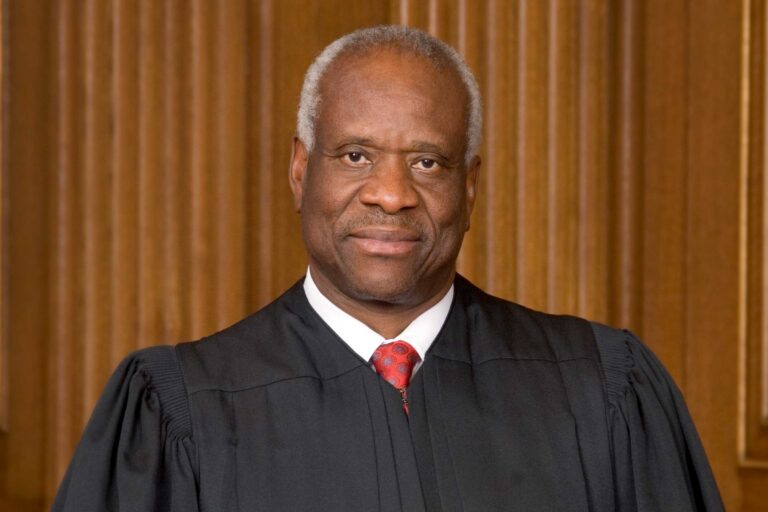
The facts of the Pungs’ case have always been almost too extraordinary to believe. Although he joined the majority opinion, Justice Thomas authored a 15-page concurrence, much of which he dedicated to recounting the Pungs’ story. Justice Gorsuch joined the substantive portions of that concurrence, including Justice Thomas’ historical analysis.
Supreme Court justices do not ordinarily spend pages rehashing the factual history of a case unless they believe those facts matter. And in the Pungs’ case, they do.
As Justice Thomas explains, the foreclosure stemmed from a disputed tax assessment that was not included on the Pungs’ original tax bill. Worse still, the County struggled to explain why the tax was ever imposed in the first place. As Justice Thomas notes, “Even a decade later, before this Court, the County could not substantiate a legitimate basis for imposing this tax.”
The result was staggering.
For a disputed debt of $2,242, Isabella County foreclosed on a home that all parties agree was worth $194,400 at the time of the taking. The property was later sold at auction for $76,008 and was eventually resold on the open market for approximately $195,000.
Echoing PLF’s argument, Justice Thomas summarizes:
“That means that even if the tax were proper—which it was not—the Pungs lost about $118,000 as a result of a supposed debt of $2,242.”
In a signature move, Justice Thomas then turns to first principles.
Quoting his own dissent in Kelo v. New London, he reminds readers that “[p]roperty is a natural, fundamental right.” He then invokes Sir William Blackstone’s observation that one of the principal purposes of government is to protect “the rights of private property.”
Justice Thomas views property rights as among the Constitution’s most important safeguards. What comes next is even more interesting.
As Justice Thomas noted, everyone agrees that “The Takings Clause forbids the government from taking a person’s property unless it provides ‘just compensation.’” In 2023, Tyler v. Hennepin County established that home equity theft was a taking, although it did not address how just compensation should be calculated, because the owner did not dispute the fair market value of the surplus. Thanks to Tyler, there is no question as to whether the government took the Pungs’ property and, therefore, owed them just compensation. The only dispute is over how much was owed.
Under ordinary takings law, Justice Thomas explains, compensation generally means fair market value. Then comes the sentence that jumps off the page:
Regardless of when exactly the history of tax foreclosure sales can justify a departure from that rule, my initial impression is that it cannot do so in this case.
Justice Thomas then methodically walks the reader through his reasoning.
“The Pungs did not receive fair market value,” he writes. Why? Because the County itself already determined the home’s value. For tax purposes, Isabella County assessed the property at $194,400. Justice Thomas points out that governments ordinarily cannot tell homeowners one thing when collecting taxes and another when defending a taking. As he puts it, the County “cannot now disavow that valuation.”
Justice Thomas is similarly unpersuaded by the argument that foreclosure somehow transformed the home’s value. The Sixth Circuit had reasoned that the foreclosure sale price represented the best evidence of value. Justice Thomas disagrees. “That argument is mistaken,” he wrote.
A home’s value does not suddenly collapse because the government initiates foreclosure proceedings. The land is the same. The house is the same. The sale does not erase the property’s underlying value.
Justice Thomas also rejects the suggestion that compensation should depend on whether the government might lose money. “It is the owner’s loss, not the taker’s gain, which is the measure of the value of the property taken,” he wrote, quoting longstanding Supreme Court precedent. In other words, the Constitution asks what the homeowner lost—not what the government can afford.
Justice Thomas then identifies what he sees as a deeper problem with the County’s claim. If compensation is measured solely by auction proceeds, there appears to be no limiting principle. To illustrate the point, Justice Thomas offers a hypothetical: Imagine a family owns a $400,000 home but owes $1,000 in taxes. Under the County’s theory, the government could seize the home, sell it for $1,000, and return nothing because there would be no surplus proceeds.
In a footnote, he reminds readers that this example “is not farfetched. According to the amicus briefs submitted in this case, local governments engage in such practices with some regularity.”
Justice Thomas then arrives at what may be the most important part of his concurrence.
The Court’s precedents recognize only two traditional exceptions to the fair market value rule: when market value is impossible to determine, or when paying market value would create a manifest injustice. Neither applies to Pung.
“It is not ‘too difficult to find’ the ‘market value’ of an ordinary suburban home,” Justice Thomas writes. “Likewise, there is no injustice, let alone manifest injustice, in paying the Pungs in full for their home.”
That leaves only one possible justification for the result: history.
History cuts both ways
The majority concludes that the history of tax foreclosure sales supports a departure from ordinary fair market value principles. Justice Thomas agrees that history can sometimes justify such an exception.
But he immediately adds an important warning: “Any exception based on history can be no broader than what that history justifies.”
Then comes perhaps the most remarkable sentence in the concurrence:
“On my initial view, any history of tax foreclosure sales reflects a greater respect for principles of just compensation than the County showed the Pungs here.”
This is where Justice Thomas’ discussion begins to resemble one of the central disputes from oral argument. The County repeatedly invoked history to justify its conduct. Justice Thomas’ response is essentially that history cuts both ways.
Historically, governments were generally required to pursue personal property before taking real property. And they were expected to seize only as much property as necessary to satisfy the debt. As Justice Thomas notes, longstanding authorities held that a sale of an entire property when a smaller amount would satisfy the tax was void.
That history creates a problem for Isabella County.
“Instead, for a mere $2,242 debt,” Justice Thomas writes, the County immediately seized the Pungs’ entire home. And although the County relies on history to defend its actions, Justice Thomas concludes that those actions “seem to have departed from that history and tradition.”
For that reason, Justice Thomas believes these questions should remain open on remand.
He ultimately closes with one of the most striking lines in his opinion:
What Isabella County did to the Pungs was wrong, and, on my initial view, likely unconstitutional.
The Supreme Court rejected our client’s just compensation claim. But Justice Thomas’ concurrence makes clear that the broader story is not over.
Indeed, the most important takeaway from the decision may be that the Court has left open the possibility that the historical traditions invoked to justify tax foreclosures could ultimately condemn what happened to the Pungs, rather than excuse it.