


The National Law Review: A Fair Process to Avoid Home Equity Theft
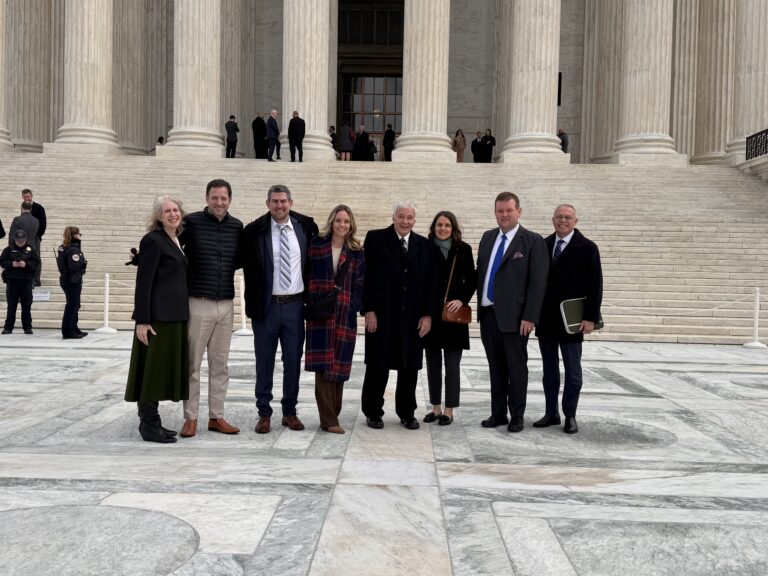
In Pung v. Isabella County, the U.S. Supreme Court this week confirmed its decision in Tyler v. Hennepin County that when the government forecloses on a home to recover unpaid property taxes, it is entitled to keep only the amount owed and remit the remainder to the property owner as just compensation.
The court clarified, however, that unlike the general rule applicable to takings, when the government conducts an auction to sell the foreclosed property, it must remit only the surplus proceeds from an auction, even if that falls well short of the property’s fair market value.
The majority opinion, authored by Justice Samuel Alito, held that the “taking” occurs when the government forecloses on the home, and that the property interest for which just compensation must be paid is the home equity. However, instead of allowing property owners to introduce evidence of the value of that equity, the court held that the baseline amount is the surplus proceeds remaining after a fairly conducted auction.
The key is that the process—including the foreclosure process leading up to the auction—must be “fairly conducted” and comparable to historical practices. The majority opinion went no further, leaving the lower courts to assess what is “fair” in tax foreclosure procedures and auctions generally, and specifically regarding the Pung family.
Justice Clarence Thomas, joined by Justice Neil Gorsuch in a concurring opinion, went further. Unlike the majority opinion, Justice Thomas detailed the county’s outrageous conduct that ultimately resulted in the foreclosure of the Pungs’ $194,000 fully paid-off house for failure to pay a disputed $1,600 tax (ballooned to $2,200 with interest and penalties). The county took title to the Pungs’ property in 2018 and sold it at auction for $76,000—approximately 40 percent of the home’s value. Because this happened before Tyler v. Hennepin County, the county kept every penny. During subsequent litigation, however, Tyler was decided, and a court ordered the county to remit the auction proceeds to the Pungs as just compensation for the equity taken.
Even so, the Pungs were deprived of $118,000 of the equitable value of the home. Justice Thomas focused on the traditional rule that just compensation must be calculated based on what the owner has lost and observed that the surplus proceeds didn’t come close:
“[S]ufficient historical evidence can justify an exception to the fair-market-value rule,… [b]ut, any exception based on history can be no broader than what that history justifies. And, on my initial view, any history of tax foreclosure sales reflects a greater respect for principles of just compensation than the County showed the Pungs here.”
While avoiding a definitive statement on what constitutes “fair conduct,” the concurrence offers some clues. It looks to historical practice that forbids foreclosure on large amounts of real property to recover relatively small tax debts. Citing the Magna Carta and early case law and statutes, Justice Thomas demonstrates that historical practice prohibits taking real property when a lesser amount of personal property (e.g., a car, furniture, or artwork) is available. “The tradition recognized that it is especially unjust to take a man’s home to settle a small debt when selling personal property would do,” Thomas wrote.
Moreover, it was historically improper for the government to take an entire property when a lesser amount would suffice to cover the debt. Thus, “a small property tax bill such as the Pungs’ would not justify an immediate sale of the entire property.” Traditionally, property owners could sue in tort to recover the value of their property that exceeded the amount of the debt, and the measure of damages was the fair market value of the property.
Justice Thomas took the county to task for unfair processes beyond the foreclosure itself. The Pungs did not receive adequate notice, nor did the county follow “rigorous procedures to ensure that the auction price of whatever property was sold matched, as nearly as possible, the fair market value of that property.”
The Supreme Court’s rule that auction proceeds are equivalent to just compensation in tax foreclosures depends on the integrity of the foreclosure process, including the auction itself. Plainly, Michigan’s procedures lack the constitutionally-mandated guardrails. As the Pung family seeks relief through the court system, property rights advocates are also pursuing legislative reforms that would prevent other families from suffering this profoundly unjust foreclosure and auction.
Pacific Legal Foundation developed a model policy to protect home equity. Possible reforms include better notice of tax delinquencies, requiring foreclosed residential properties to be sold by a real estate agent, requiring public auctions of non-residential properties, and using a state’s existing abandoned property process to quickly return surplus equity to homeowners after back taxes are paid. Oregon adopted most of these reforms last year. Other jurisdictions should hasten to follow suit.
This op-ed was originally published in The National Law Review on June 26, 2026.