

The battle isn’t over: What Pung means for the fight against home equity theft

Near the end of this year’s term, the Supreme Court handed down its decision in Pung v. Isabella County, rejecting the argument that the Fifth Amendment’s Takings Clause requires government to pay fair market value to homeowners when it seizes and sells their homes to collect a tax debt. That was the question presented in the case, and the Court disagreed.
But placed in its full context, a different picture of the case emerges. The Pung family’s case was given a second life, and the Court’s decision is not a defeat for the broader movement to end home equity theft in America. In many ways, it is exactly where we needed to land.
Pacific Legal Foundation launched its End Home Equity Theft initiative in 2019 with a simple but powerful premise: when governments seize a home to collect a tax debt and pocket the proceeds beyond the amount owed, they are taking private property without just compensation, in violation of the Fifth Amendment. The Constitution requires that owners get their surplus equity back.
For years, states from Michigan to Nebraska to Minnesota operated regimes that allowed exactly this kind of legalized plunder. A homeowner might owe $1,000 in back taxes on a $100,000 home, lose the entire property to foreclosure, watch the government sell it and pocket everything, leaving the owner with nothing. Governments called it tax collection. We called it what it was: theft.
After years of litigation across dozens of cases, the Supreme Court agreed with us in Tyler v. Hennepin County (2023). In Tyler, a unanimous Court held that the Fifth Amendment requires governments to return surplus proceeds from tax foreclosure sales. The constitutional principle was established. Governments cannot keep more than what they are owed.
In one crucial respect, Pung builds on Tyler in ways that will matter enormously for finishing the job.
The Pung family’s story is among the most troubling in our cases. They never legitimately owed the tax that triggered their foreclosure. A local assessor had already been told by a court that the same tax imposed in prior years was unlawful. She said of the judge who ruled against her, “I don’t care what he says,” and reassessed the same taxes anyway the following year. The family’s home, assessed at $194,400, was sold at auction for less than 40 percent of its value—$76,008. Eighteen months later, the buyer resold it for $195,000.
The Court declined to hold that the Takings Clause requires full fair market value compensation in some tax sale cases. That’s a disappointment, and we won’t pretend otherwise. A better opinion would have looked more like Justice Thomas’s concurrence, which laid out in careful historical detail why the County’s conduct violated not just basic fairness but the historical traditions that govern tax sales.
But the majority opinion contains something of enormous consequence for property owners: a fairness proviso. The Court held that surplus proceeds from a tax sale satisfy the Takings Clause only when the sale is “fairly conducted in light of our country’s history of tax sales.” That phrase is not window dressing. It is a constitutional requirement and now the law of the land.
Home equity theft doesn’t always look like a government brazenly pocketing a windfall. Sometimes it operates through procedural manipulation—sales conducted with inadequate notice, auctions structured to depress prices, seizures of entire properties when a partial sale or lien would have sufficed. The historical record Justice Thomas surveyed in his concurrence makes clear that these practices were never acceptable under the traditional law of tax sales. Now, under Pung, they are constitutionally suspect.
This matters enormously for the states that still engage in home equity theft. After Tyler, we worked with legislators in nearly every offending state to reform their laws, and we made remarkable progress. Most states now return surplus proceeds as the Constitution requires. But a handful of recalcitrant states, and the District of Columbia, have resisted meaningful reform. In those places, the fairness proviso gives us exactly the tool we need. Where sales are conducted with inadequate notice, where entire homes are seized for trivial debts when less drastic remedies are available, or where auction procedures are structured to generate artificially depressed prices, Pung puts those practices in constitutional jeopardy.
When PLF began this work, our goal was never a single headline victory. It was to establish constitutional principles that would make home equity theft impossible, and then to use those principles to systematically end the practice state by state. Tyler gave us the foundation. Pung’s fairness proviso gives us the momentum needed to finish the job.
The Pung family’s case is not over. The Supreme Court vacated and remanded the case to the lower court, leaving open the question of whether the County’s specific procedures were constitutionally adequate. Justice Thomas’s concurrence, joined by Justice Gorsuch, made clear that at least two Justices believe the County’s conduct was likely unconstitutional. That fight continues.
So does ours at PLF. The Supreme Court did not give us all we asked for in Pung. But the Constitution now clearly requires that tax sales be fairly conducted and that owners receive their surplus equity. That is what we set out to achieve seven years ago. We are not done—but we are winning.
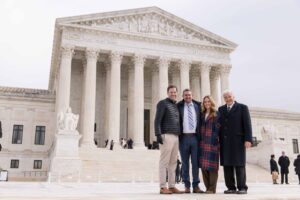
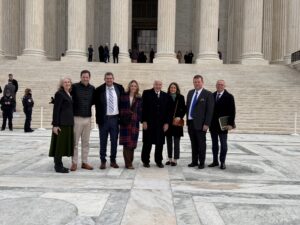
Larry Salzman is the Vice President for Litigation and Strategy at Pacific Legal Foundation. Christina Martin is a senior attorney in PLF’s Property Rights practice group. They co-represented the Pungs in their lawsuit against Isabella County.