

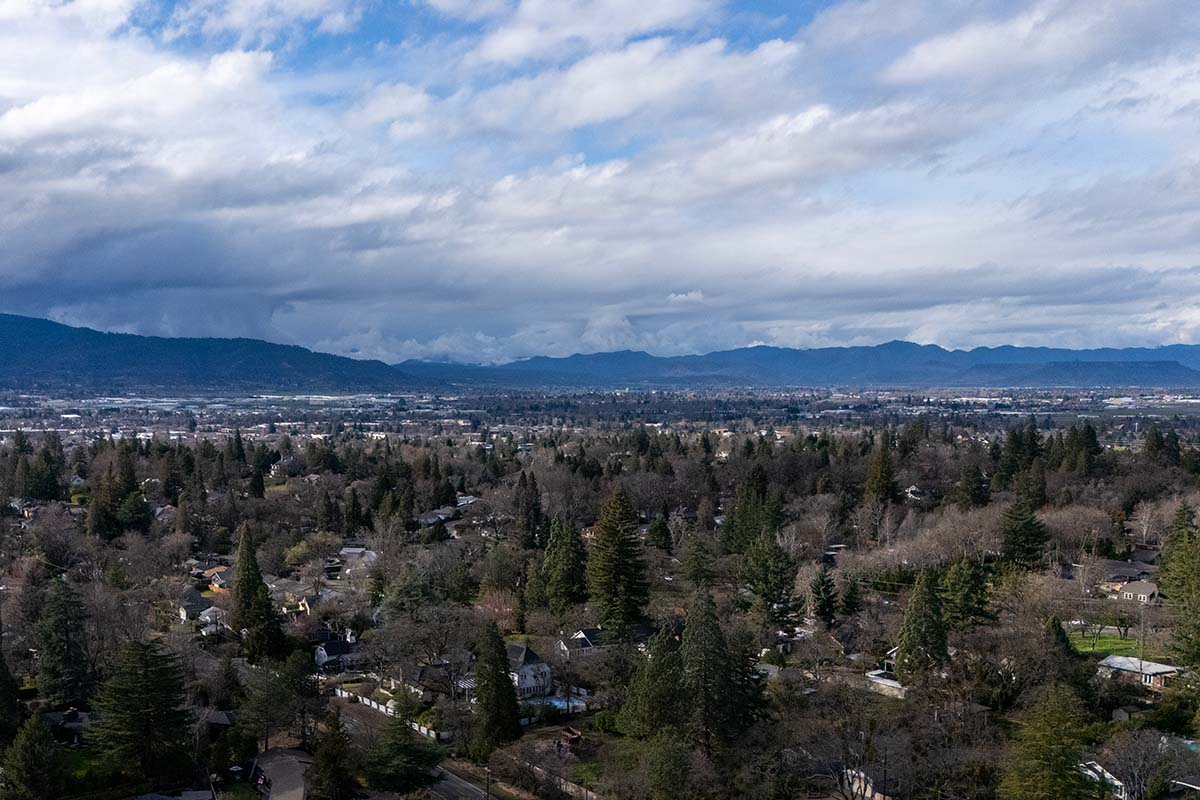
When the timber industry changed, KOGAP Enterprises—a family-owned Oregon business—decided to transform their former sawmill site into Stewart Meadows Village, a planned 121-acre development in Medford. After 15 years of working cooperatively with the city through numerous approvals, KOGAP found itself targeted by officials who wanted to shift the cost of public infrastructure onto private developers.
Myers Lane, a dead-end rural road serving eleven homes, terminates at KOGAP’s property. The city wanted to extend that road across KOGAP’s land to serve future development, but didn’t want to pay for it. In 2022, when KOGAP applied for routine revisions generating no additional traffic, Medford imposed a stunning condition: dedicate valuable property, construct the road, and pay half the cost of a bridge (not even located on the property)—over $700,000 total.
The irony was sharp. Two years earlier, Medford’s own city attorney recommended withdrawing a nearly identical demand, concluding it “may not survive a Nollan/Dolan challenge.” The planning commission agreed the condition “was an unlawful exaction.” Yet when KOGAP returned, the city renewed its demand for the same improvements.
City staff openly acknowledged the exaction wasn’t intended to mitigate KOGAP’s impacts but to serve “a significant amount of developable land south and west of Stewart Meadows Village”—other people’s future projects. The city’s own traffic expert confirmed KOGAP’s revision would create “no new trips.”
KOGAP filed a lawsuit to challenge the exaction. After losing in district court, KOGAP filed a federal appeal to defend Oregon property owners’ constitutional rights, arguing that the government cannot force individual property owners to shoulder public infrastructure costs and asking the U.S. Court of Appeals for the Ninth Circuit to decide whether cities can extort developers simply because they own conveniently located land.
In a ruling issued on November 13, 2025, the Ninth Circuit Court reversed the district court’s prior decision and ruled in KOGAP’s favor.
“The government cannot use the permit process to pressure private businesses or individuals to subsidize public infrastructure,” said Brian Hodges, attorney with Pacific Legal Foundation, which represented KOGAP at no cost. “The Supreme Court has repeatedly held that it is unconstitutional to single out property owners to shoulder massive costs for the public. We are thrilled that the court applied that precedent today in defense of Oregonians’ property rights.”
What’s At Stake?
- The government cannot force developers to foot the bill for problems they do not create.
- Singling out some property owners to pay a disproportionate share of the cost of public roads and bridges used by everyone is unfair, and the Supreme Court has repeatedly said this is unconstitutional. Such costs are extortion that drives up the price of housing for everyone.