

One family’s fight to save their multigenerational Idaho potato farm
Author Margaret Mitchell once wrote, “Land is the only thing in the world worth working for, worth fighting for, worth dying for, because it’s the only thing that lasts.”
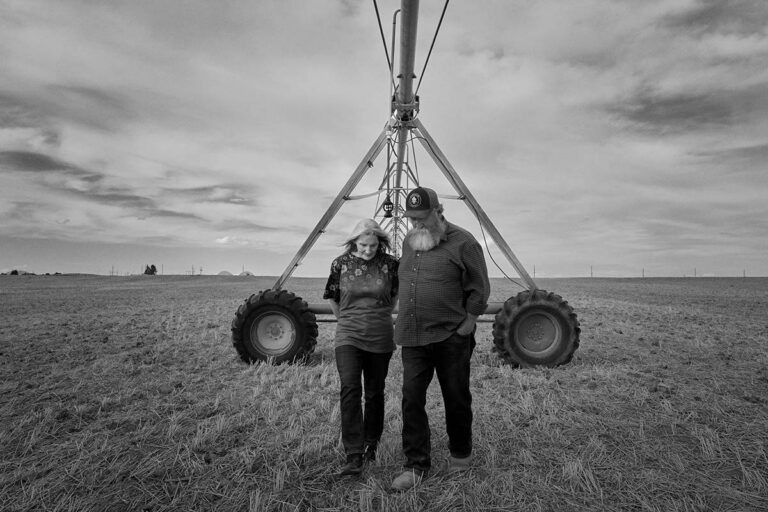
For Jerry Bingham, his family’s Idaho farm is more than land. It’s the only home he’s ever known. In 1950, his father purchased the thousand-acre farm near Blackfoot, Idaho. Jerry was born and raised on the property, carried his new wife over the threshold, raised his family there, and harvested countless potatoes—or “spuds,” as Jerry calls them.
But a threat from a state agency has put the farm’s future in jeopardy, and Jerry now finds himself in a lawsuit to protect the land that has shaped his life and his family for generations.
The land that raised a family
Jerry and Valerie Bingham have the kind of idyllic country life people dream of having.
The couple first met in kindergarten, but their love story didn’t begin until junior high. Jerry still remembers the moment he knew Valerie would someday be his wife. “It was lunchtime and I was sitting with my friends. She walked in with some big glasses on that had windshield wipers on them. People think I’m crazy, but I heard a voice say, ‘That’s who you’re going to marry.’”
Valerie smiled hearing Jerry’s recollection but confessed that she did not hear the same voice.
Eventually, Jerry won Valerie over. Together, the couple has celebrated 46 wedding anniversaries, raised six children, welcomed 23 grandchildren, and sustained and expanded their multigenerational farming operation.
Life moves at a slower pace in rural Idaho, but the potato harvest keeps the Binghams busy. Farmwork is a family affair, with their children and grandchildren all pitching in to help. Watching his children work the land and develop the same love for it means the world to Jerry, who always knew his calling was farming.
“I just loved driving the tractors, working the ground, and seeing how everything you did improved the land and made the farm look pretty,” Jerry says. As a kid, Jerry preferred farming to school, but his father always reminded him that he “ain’t going to partner with a dropout.”
School wasn’t his forte, but Valerie helped him graduate. “She got me through high school. She did a lot of my homework. She got two diplomas, one with my name on it,” Jerry says. Valerie even recalls several instances of teachers writing on the top of Jerry’s tests: “Tell Valerie good job.”
Jerry always assumed that he would someday take over the farm for his father; he just never thought it would happen so soon.
In 1983, when Jerry was only 23, he unexpectedly lost his father and two brothers in a fatal plane crash. Uncertainty loomed over the family. Jerry’s mother tried desperately to hang on to the family farm but was unable to bear the weight of the finances.
In a devastating blow to the family, the bank eventually took the farm. While he was just a young man at the time, Jerry knew he had to help his family preserve their legacy.
I was able to resurrect some old equipment that was worthless. I had one tractor and found a guy that would sell me fertilizer and stuff. The bank rented me the ground back for three years until I’d done well enough, and then they sold me the farm back. So it’s been quite a miracle.
He later discovered that his neighbors had helped to keep the farm in the Bingham family.
I was very lucky that people knew my dad. He was a good man, and they supported me too. The bank tried to sell it to a lot of big farmers around me. When I signed the papers to buy it back, I was told that my neighbors refused to buy it because they wanted me to get the family farm back.
Jerry has never forgotten how close his family came to losing their land. “It’s more than just a piece of ground to make some money on and raise crops. I grew up on it. I don’t want to lose it.”
Now, the threat of losing the farm is back once again, but this time it is due not to a family tragedy but to unconstitutional state action.
First in time, first in right
To understand the current threats to the Binghams’ land, it’s vital to understand how water rights work in Idaho.
The state operates under the prior appropriation doctrine, commonly known as “first in time, first in right.” Water rights form a line, with priority determined by date. When there isn’t enough water to go around, senior—or older—rights are satisfied before junior rights.
The Bingham family owns some of the most senior rights for pumping groundwater from the Eastern Snake River Plain Aquifer. That was intentional. When Jerry’s father was looking to purchase land, he purposefully searched for farms with 1950, 1951, or 1952 water rights to ensure seniority.
“You could have got the farm cheap and drilled the well, but you would’ve had a 1980 water right. So common sense said you’re taking a risk,” Jerry says.
The Binghams are among the most senior groundwater rights in the aquifer. But in July 2025, the Idaho Department of Water Resources broadened its cutoff and ordered groundwater users with rights after 1900 to either stop pumping or operate under an IDWR-approved mitigation plan, including by joining a groundwater district with an approved plan.
By design, Jerry wasn’t a member of a water district. “I don’t want to be part of this district because I have senior water rights and that gives me a safe harbor from ever being curtailed.”
Joining a district meant paying assessments and sharing the burden of cutbacks with junior water users. At one point, assessments reached $26.50 per acre—nearly $27,000 for the Bingham farm. Jerry would also have to reduce irrigation by 11%–12%.
To Jerry, the arrangement made little sense: He would leave some of his own land dry while paying into a plan that helped junior farmers keep watering theirs.
Left high and dry
Without water, the Binghams cannot raise their crops. Since the 2025 order, they have only been allowed to turn on their pumps once, in April 2026.
The Binghams tried to work something out with IDWR, presenting five proposed mitigation strategies that would enable them to preserve their rights and their family farm. Their proposals were rejected.
The Binghams have a right to exercise their water rights to their fullest scope. Instead, they have been deprived of their property rights in accessing and using groundwater. Under Idaho’s law of prior appropriation, IDWR must respect the Binghams’ relative seniority in its curtailment orders and mitigation plans. And under the U.S. Constitution’s Takings Clause, when the government takes private property for public use, it must pay just compensation.
The consequences of the shutoff have been devastating. In 2025 and 2026, the Binghams were unable to plant potatoes on their own farm and had to rent other land, resulting in roughly $300,000 in lost revenue. They have also spent more than two-thirds of their retirement savings fighting IDWR.
But the greatest potential loss cannot be measured in dollars. For Valerie, losing the farm would mean losing a way of life the couple hoped to pass down to future generations. “It’s where we raised our kids, where they learned to work. They liked it so much that they wanted to come back and raise their families.”
The family’s history is quite literally imprinted on the farm. “We even have grain bins out here with our handprints in it,” Jerry says.
What’s right is right
After getting nowhere with IDWR, Jerry turned to his attorney nephew, who connected him with another attorney. The attorney told Jerry that what IDWR was doing was wrong and that there might be a legal avenue to fight it. But hope wasn’t enough to cover the legal bills a lawsuit would surely bring.
Fortunately, the attorney had worked with Pacific Legal Foundation in the past and suggested PLF might take the case free of charge. The Binghams connected with PLF and, together, filed a lawsuit asking for a return to the lawful, predictable framework Idaho farmers need to steward resources, grow food, and plan for the future.
While their family’s legacy is a top concern, the Binghams understand the case is bigger than their farm.
“I’m not just doing it for me,” Jerry says. “Most of my neighbors have ’48, ’52 water rights, and they’re looking for someone to show them how they can get out of a water district and just rely on what their water rights should give them a safe harbor from. So it’s not just being stingy for myself. I’m trying to help a lot of people.”
Through it all, Jerry often thinks of his father.
“He always told me what’s right is right. What is wrong is wrong. I know I’m doing what’s right, and he would be okay with that, especially trying to save something that means so much to the family.”
For Jerry, doing what’s right means fighting once again for the land his family has called home for generations.
Photography by Rick Wenner, Pacific Legal Foundation.