Weaponized environmental litigation halts home building across the country

This November, Californians have the chance to vote on a proposed reform to the state’s environmental review process—a process that has been weaponized to halt construction projects across the state for years at a time.
Proposition 45 aims to reform the California Environmental Quality Act (CEQA). While CEQA’s intention is to adequately assess and mitigate environmental harm from construction, the requirement to assess and review environmentally significant impacts has been weaponized by special interest groups to effectively control development decisions. Litigants often assert improper exemption of a project or inadequate environmental review if it is required, pausing essential construction in California, including housing. According to one study, CEQA litigation typically blocks home-building for four to five years and halted nearly half of the state’s approved housing production in 2020.
If approved, Proposition 45’s reforms would include tightening timelines for these court challenges to 270 days. Purportedly, the changes in the proposition would decrease the cost of the average home for Californians by $75,000.
The problem is national
Weaponized environmental review isn’t limited to California. We recently published research on the seven other states and DC that have state environmental policy acts (SEPAs) like California’s that allow third parties to sue to halt home building that is desperately needed during today’s housing crisis. Additionally, eight states have state environmental rights amendments (SERAs), which allow litigants to assert that home building violates their right to a clean, healthy environment under the state’s constitution.
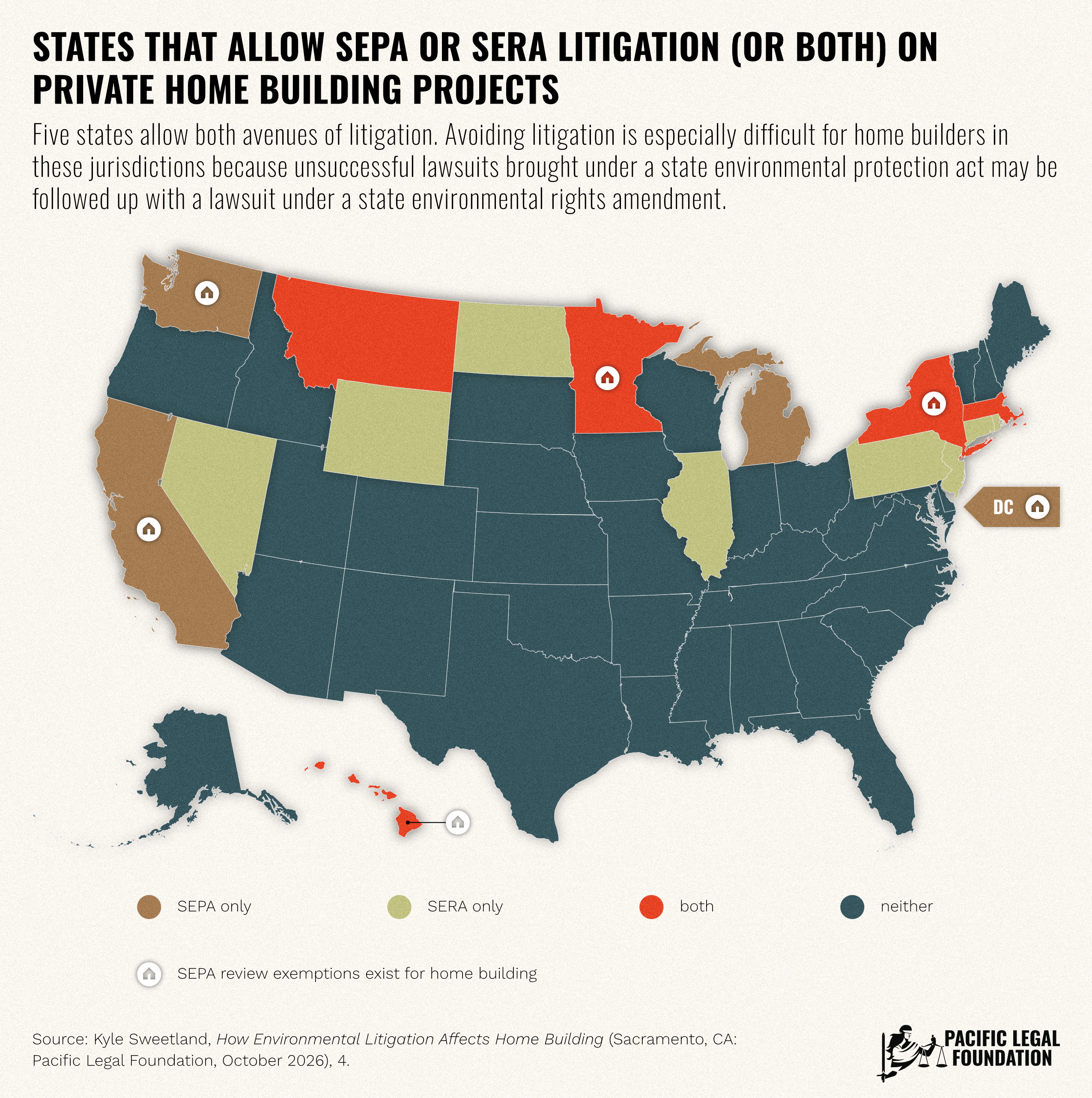
When litigation happens to take place in a state with SEPA and SERA, then SERA can act like a legal backstop if SEPA litigation fails. This makes these states—Hawaii, Massachusetts, Montana, Minnesota, and New York—especially difficult for home builders whose projects are affected by SEPA.
This is exactly what happened in Minnesota. Two environmental groups sued the city of Minneapolis under the Minnesota Environmental Rights Act after a district court dismissed a lawsuit filed under the Minnesota Environmental Policy Act. The environmental groups’ lawsuit led to a September 2023 injunction that prevented more than 500 housing units from being built until the lawsuit was dismissed in January 2025.
These weaponized suits don’t always benefit the environment
The irony of these lawsuits is that they may not protect the environment. In the case in Minneapolis, an environmental group argued that the city’s plan would result in lower emissions—not higher emissions as the plaintiffs argued—due to denser housing requiring less driving. New York has also revealed little evidence of environmental protection resulting from these lawsuits. For example, a 2024 review of SEPA lawsuit decisions in New York revealed that only one of the 10 residential building lawsuit decisions resulted in evidence of environmental harm.
Exemptions for home building may not be enough
As my research details, states and their cities have taken steps to exempt at least some home building from environmental review. For example, in 2024, New York City exempted smaller residential building plans of up to 250 housing units from the state’s and city’s environmental policy acts. In another example, Seattle exempted all residential development—the highest allowed under the state’s SEPA—possibly reducing permitting times by at least six months.
These exemptions may result in faster approvals and fewer home building projects being targeted for environmental lawsuits. But they also might still allow some home building to be subject to frivolous SEPA or SERA lawsuits.
Additionally, they do not place the burdens of evidence and litigation costs on the plaintiffs who sue. In the Minneapolis case previously mentioned, the city was ordered to prove the environmental groups’ claims of harm were invalid instead of the other way around. On litigation costs, in California, private parties do not typically have to pay the opposing attorney’s fees if they lose. If they win, however, they can stop housing from being built and have the defendant pay their attorney’s fees.
Addressing the problem of weaponized environmental lawsuits
Pacific Legal Foundation has a great solution to this found in the Third-Party Permit Challenges to Development Permits Act. It would block third parties from suing to challenge local government permitting decisions unless the third party’s own property is adjacent to the proposed development and can prove that the proposed development will harm them. The model bill also would create an expedited review process—requiring challenges to be resolved within 60 days—and would place the burden of paying attorney’s fees and legal costs on the objector if they lose.
Environmental litigation under SEPA and SERA appears to be an often-unnecessary barrier to home building in many states. But we are not without the means to address it and make homes more abundant and affordable.