


Boston Public Schools (BPS) runs three “exam schools” for students in grades 7-12, which U.S. News & World Report ranks among the nation’s best. Boston Latin School, in particular, is the oldest operating school in the U.S. and counts among its alumni many important figures in American history.
Admission to these schools was traditionally decided on a merit-based “composite score” comprised of grade point average (GPA) and an admissions exam. Students were admitted by score rankings until each school was full.
The competition for these seats is fierce and, as one mother explains, begins as early as 4th and 5th grade:
“We’re talking about nine and ten year old kids talking about big topics and choices that have enormous financial consequences on the families. They’re facing very difficult conversations not only about their future in education but also finances. When we go back to the mental health, I don’t know how they’re able to process all of those elements.”
In fall 2020, amid the COVID-19 pandemic, BPS overhauled the admissions criteria, removing the exam component and creating a ZIP Code quota system. While this strategy seemed benign, the motivations behind it were anything but: BPS and its admissions task force were clear—they wanted a specific racial balance at the exam schools.
The task force was led by the Boston NAACP president and included a critical theorist academic and a corporate head of diversity. Another member had previously written about the exam schools’ purported racial inequity.
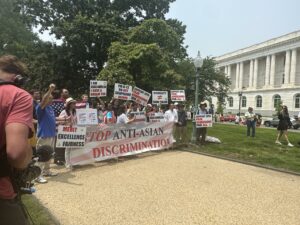
The ZIP Code quota had immediate impact. In fall 2021, white student numbers dropped from 40% to 31% while the Asian American count fell from 21% to 18%. Among the students denied equal educational opportunities were children whose parents are members of the nonprofit Boston Parent Coalition for Academic Excellence that supports merit-based admissions and improving the district’s K-6 pipeline.
The Coalition sued, arguing that ZIP Codes used as a racial proxy violate the Constitution’s equal protection guarantee. The case was dismissed by a federal trial court and then by the First Circuit, which said the Coalition couldn’t prove the policy’s disparate—or disproportionate—impact on white and Asian American students. Ultimately, the Supreme Court also declined review, prompting a scorching dissent from Justice Samuel Alito that concluded: “We have now twice refused to correct a glaring constitutional error that threatens to perpetuate race-based affirmative action in defiance of Students for Fair Admissions. I would reject root and branch this dangerously distorted view of disparate impact.”
While that case wove through the courts, BPS reconvened its task force and replaced the ZIP Code scheme with a “tier plan” that divides Boston into socioeconomic tiers.
The district allots each “tier” the same number of seats, but any semblance of equality ends there. Admission cutoff scores vary wildly by tier. For example, when the plan was first implemented, there were eight tiers, and Boston Latin School required a 99.1 composite score from Tier 8 students but only 73.5 from Tier 3 students. Tier 8 not only had the most applicants of any tier by far, but the vast majority of white applicants were competing against only each other in Tier 8. Consequently, students in Tier 8 had the lowest acceptance rate, and white students fell to about a quarter of the admitted students at the exam schools. Importantly, this share placed white students below their proportion of the applicant pool—the standard the First Circuit said was necessary to demonstrate disparate impact in the first case.
The new plan worked: BPS achieved its clearly stated goal of racial balancing. But this new admissions scheme is just as unconstitutional as the ZIP Code system: it intends to discriminate on the basis of race and is successful at doing so. Under the Constitution’s equal protection guarantee, public schools cannot design admissions criteria to intentionally suppress enrollment of students from particular racial groups—whether directly or by proxy.
Represented at no charge by Pacific Legal Foundation, Boston Parents are again fighting back with a federal lawsuit, armed this time with evidence of disparate impact and signals of an appetite among Supreme Court justices to decide the fate of government-sponsored discrimination-by-proxy once and for all.
This case builds on our previous work, demonstrating PLF’s relentless efforts to defend the Constitution’s promise of equality under the law. All students deserve equal educational opportunities based on individual qualifications and achievement, not government preferences based on characteristics they cannot control.
What’s At Stake?
- All students deserve to be considered for educational opportunities based on their individual merit, not the color of their skin.
- It is immoral and unconstitutional for the government to consider a student’s race—whether directly or by proxy—in public school admissions. School districts cannot design admissions criteria to intentionally suppress the enrollment of students from particular racial groups.